
Stamped and decorative concrete in Northern Virginia
Decorative concrete keeps the strength and simplicity of a poured slab and changes how it looks and feels underfoot. Blackline Builders pours stamped concrete, along with colored and textured finishes, for patios, walkways, steps and driveways across Northern Virginia.
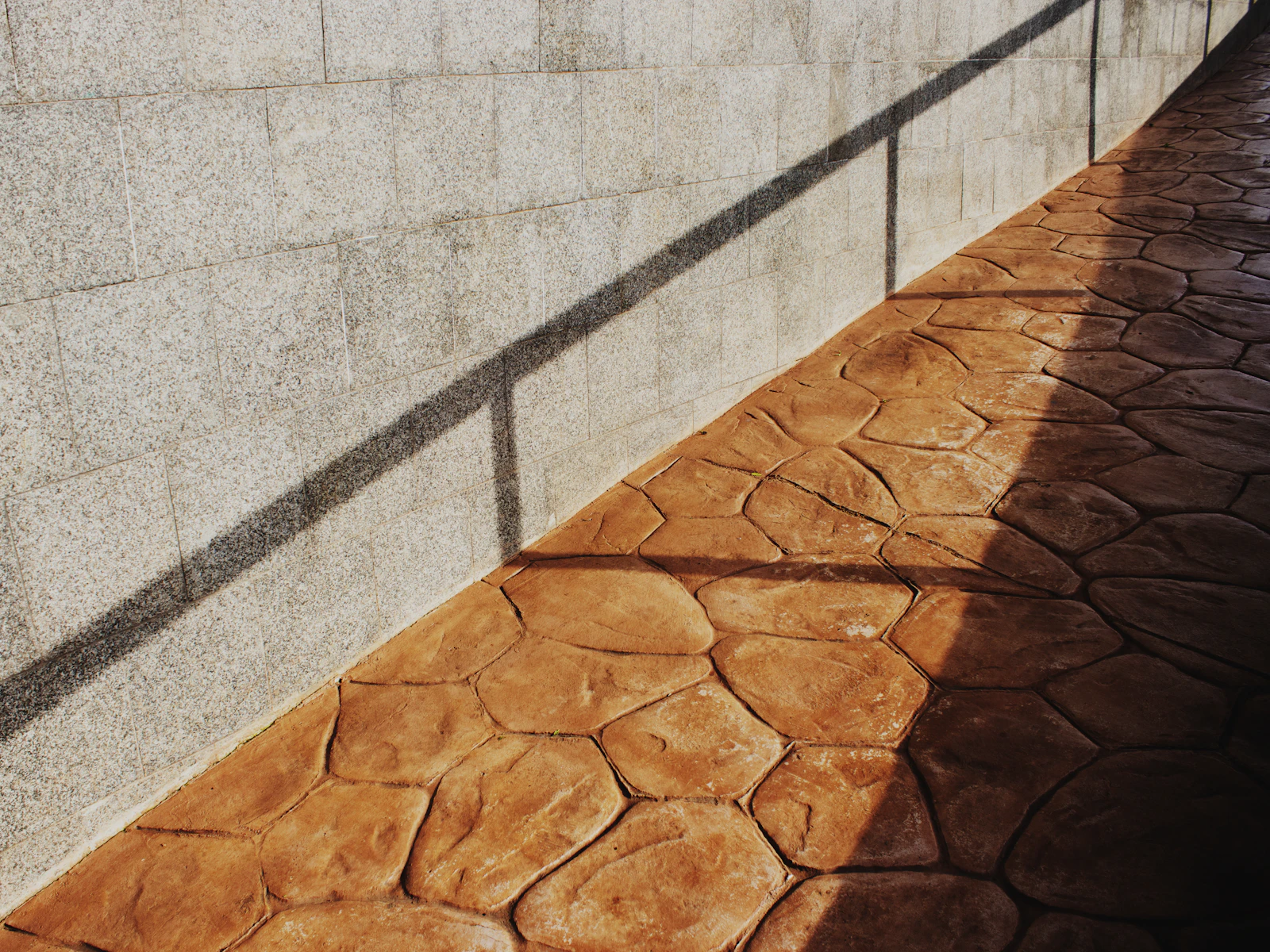
Restraint tends to read as quality. One pattern, a color taken from the house, clean borders and joints that sit within the pattern rather than across it: that is usually enough.
What decorative concrete work includes
- Pattern, texture and color chosen against the brick, stone, siding and trim of your house
- Integral color mixed through the concrete, a color hardener worked into the surface, or both
- Release agents that add depth and a softer, aged tone to the pattern
- Borders, bands and saw-cut details that frame a patio, walk or drive
- A joint plan that places control joints along pattern lines wherever the layout allows
- The same excavation, stone base, forms and reinforcement as plain concrete
- Cleaning and sealing once the concrete has cured
- Care notes covering resealing and winter de-icing
A pattern cannot hide a crack, and color cannot fix a surface that holds water. The base, slope and joints are settled first, and the pattern is chosen to work with them.
How a stamped surface comes together
- On-site estimate. We look at the house, the existing hardscape, sun and shade, and how the space is used day to day.
- Design. Layout, pattern, colors and borders are drawn up and settled with you before a pour date is set.
- Approvals. Community association or historic review is checked, and the application prepared where one is needed.
- Marking utilities. Underground lines are located through Virginia 811 before any excavation.
- Base and forms. Excavation, stone base, forms and reinforcement.
- Pour, color and stamp. Stamping happens while the concrete is still workable, so tools, color and crew are staged before the pour begins.
- Joints and sealing. Control joints are cut, the surface is cleaned and sealer is applied.
- Walkthrough. We review the work and go over care with you.
The wider sequence is described in our process.
Planning decorative concrete in Northern Virginia
Community design review. Color and pattern are the kind of change planned communities review. Brambleton's design review covers patios as well as changes in color and materials, and Broadlands requires written approval in hand before patio, walkway or driveway work starts. A clear site plan and color details help those applications.
Historic districts. In Haymarket, where the town council adopted historic district zoning for the entire town in 1994, new construction needs a certificate of appropriateness from the Architectural Review Board. If decorative work will be visible from the street, ask the town early.
Permits. An on-grade concrete patio in Fairfax County needs no building permit, though the county adds that size and location can bring other approvals. Rules differ by county, city and town, so we check yours.
Winters. Arlington County's design criteria rate weathering as severe, and Prince William County's typical residential specifications make air entrainment the rule for exposed exterior concrete. Air entrainment leaves tiny, evenly spaced air voids in the concrete that give freezing water room to expand. Decorative surfaces face the same freezing, thawing and de-icing salt as plain ones.
Soils. Prince William County lists high shrink-swell soils and marine clay among its problem soils. A stamped slab rests on the ground like any plain one, so where those soils are present, the base and drainage deserve the same care.
Questions about stamped and decorative concrete
Color can be mixed through the whole slab, worked into the fresh surface as a color hardener, or both. A contrasting release agent is often used during stamping to give the pattern depth. Once the concrete has cured and been cleaned, a sealer is applied to protect the surface and deepen the color. Sealers wear with foot traffic and weather, so they are renewed from time to time.
Both can make a handsome patio. Stamped concrete is one continuous slab, with its joints planned into the pattern. Pavers are individual units set on a compacted base, so small areas can be lifted and reset. The choice usually comes down to the look you want, the shape of the space and how you plan to maintain it. This service covers poured concrete, and we can talk through the comparison on site.
Yes, when the base, reinforcement and joint layout are planned for vehicles. Deep textures can collect grit and make snow clearing harder, so a subtler texture, or a stamped border framing a broom-finished drive, is a common approach.
A sealed surface can be slicker when wet than broom-finished concrete. Texture helps, and a fine anti-slip additive can be mixed into the sealer for steps, landings and areas that stay damp. We plan for this on any surface near a door or on a slope.
To see what a decorative finish could do for your patio, walk or drive, book a free on-site estimate or call 571-200-3100.
Start a project
Bring us the lot—or the home you want to transform.
We'll meet you on site, walk the property with you and talk through what the work will take.